Does Mule Bone Represent the Real Negro Art Theatre
When Hurston Had a (Mule) Bone to Pick with Hughes
Did Zora Neale Hurston's refusal to compromise with Langston Hughes secure her literary legacy?
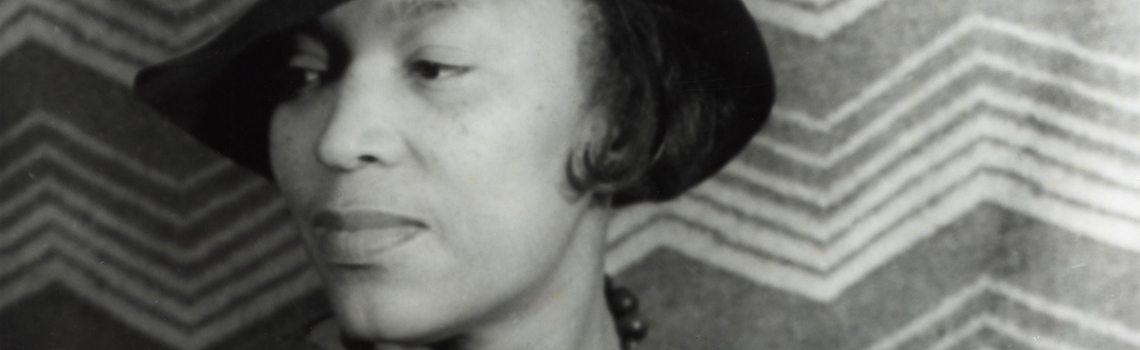
Earlier this year, the publication of Zora Neale Hurston's first total-length book, Barracoon, caused a major ripple in the international literary earth. For several decades the piece of work saturday unknown except to the most fervent scholars until the Hurston manor decided to have the story at long last available to the public.
This development reminded u.s.a. of another work by Hurston, Mule Bone, written in 1930 and unpublished until 1984 – nearly 20 years after her death. Hurston penned Mule Bone, a dramatic folk-comedy, in collaboration with her fellow colonnade of the Harlem Renaissance, Langston Hughes. The concept of Mule Os was based on a folktale she'd learned in Eatonville, the all-Black Florida community where Hurston grew up and conducted much of her anthropological research.
When she presented the idea for the play to Hughes, Hurston wasn't just seeking his help in writing a play. She had a vision for a new kind of theater intended for African American audiences, penned by African American authors, depicting life the way they lived it, in opposition to the Black stereotypes of minstrel shows created to entertain mainstream, mostly white audiences.
Why did it have and then long for Mule Bone, an important, insightful piece of Hurston'south literary legacy, to become published? And why, when information technology finally fabricated its stage debut on Broadway in 1991, was it such a flop?
A "fragmented and problematic" collaboration
Clues for what went incorrect with Mule Bone are laid out in a review of the 1991 functioning by New York Times critic Frank Rich1:
On occasion – rare occasion – this rendition does make articulate what Hurston and Hughes had in listen, which was to bring to the stage, unfiltered by white sensibilities, the 18-carat language, culture and lives of blackness people who had been shaped by both a rich African heritage and the oppression of American racism.
Despite these moments of clarity in the production, Rich claimed that the play'southward text "oft feels like a rough typhoon in which two competing voices were trying to make a compromise," and he wondered "Perhaps if the writers had had the chance to finish Mule Bone and to meet information technology with an audience, they would have tightened or rethought what was a work in progress."
For the most part, the play was plagued past the "fragmented and problematic" "aborted collaboration" of Hurston and Hughes. Any acquired the legendary rift between the writers is the stuff of much speculation, but Rich noted that most accounts hold that it "at the very least involved a battle over authorial credit."
In her dissertation, The Burn that Genius Brings: Inventiveness and the Unhealed Companionship Between Zora Neale Hurston and Langston Hughes, scholar Sharon Dorothy Johnsonii took a unique tack in examining the failed relationship. She wrote:
These two people [Hurston and Hughes], who hung out together, corresponded about daily, supported each other emotionally, and at times financially, shared immense talent and like desire and goal to represent Black life in all of its color and complexity. This intimate bond was unraveled by a dispute over authorship of Mule Bone, to the point that, co-ordinate to Hughes, they never spoke to each other again afterwards that.
Johnson employed tools of Jungian theory to criticize near conventional scholarship on the human relationship between 2 of the almost iconic writers of the Harlem Renaissance. She makes the case that much of this scholarship is rooted in "patriarchy and sexism" and so that "Hurston bears the brunt of existence seen every bit the villain, responsible for the demise of her friendship and artistic collaboration with Hughes."
One of the critics Johnson takes to job is Henry Louis Gates, who according to Johnson noted that Hurston'southward act of copywriting Mule Os in her name just sparked the disintegration of their friendship. Yet, Johnson made the case that "Hurston should have registered a typhoon solely in her proper name, albeit earlier soliciting Hughes, or anyone else, for feedback or input," as "the text of the play is based on 'The Bone of Contention,' Hurston's previously unpublished short story inspired past a folktale she collected during her academic research and fieldwork in the Deep Southward."
The original story (like much of Hurston's writing) was steeped in the "rituals, traditions and vernacular that Hurston knew well as a child growing up in Eatonville," Johnson wrote, and she rejected changes that Hughes made which turned the story'south central plot bespeak, an argument nigh turkey, into an statement almost a woman. The play, meant to be about a religious and political dispute, Johnson continues, became the story of a love triangle, undermining the original folktale on which information technology was based.
From this point of view, could it be argued that Hurston took action that, though unfair, was necessary to protect her intention of authentically depicting the lives of people in Eatonville – a critical component of her literary legacy?
Why Mule Os remains a critical piece of Hurston's legacy
Johnson also takes outcome that much of Hurston'south writings, including Mule Bone, "were sanctioned and edited by Gates [so] that his editorial decisions, voice, and scholarly interpretations dominate the landscape" of her work. While Johnson raises a critical point, it's besides of import to note Gates was a staunch champion of bringing Hurston's piece of work to the public. Many works, including Mule Os, wouldn't probable be attainable to us if information technology had not been for Gates' commitment to publishing Hurston'southward entire body of literature in the 1980s.
When the Mule Bone was finally published in 1984 (thanks to Gates), it stirred up a whole new generation of controversy, "especially amidst Black readers and critics who were uncomfortable with "the exclusive apply of Black vernacular equally the linguistic communication of drama," he wrote in The New York Times. three
Gates explained that Mule Os "portrays what Black people say and think and feel – when no white people are around," adding that "the experience [of the play] called to heed sitting in a barbershop or a church meeting – any number of ritualized or communal settings.
"The boldness of Hughes and Hurston," he continued, "was that they dared to unveil one of these ritual settings and hoped to base a new idea of theater on it."
The merits of staging the play were debated at a forum in 1988, where Gates recalled i contemporary playwright noting Hurston's linguistic communication "always fabricated blackness people nervous because information technology reflects rural diction and syntax – the creation of a different kind of English."
But scholar Jennifer Staple 4 constitute that to exist a positive attribute of Hurston'southward literary innovation. Staple wrote that the language and expressions of Mule Os presented a whole new kind of writing that married ethnography and drama. Mule Bone demonstrated how Hurston "embraced the anthropological method to engage in the aboveboard inscription of Eatonville'due south folklore…[Hurston] resisted the dramatic practices of her predecessors by employing novel artistic techniques that reinvented the fields of theater and anthropology."
Staple noted how oral tradition – the way African Americans really speak of their experiences – "was 1 of the about important aspects of Hurston's realistic representation of Eatonville:" "Mule Os employed oral tradition to exemplify the ethnographic concepts of ritual, functioning and social structure," she wrote.
Gates went on to telephone call the Mule Os "a false start that remains 1 of American theater's more tantalizing might-have-beens." Gates also lamented the unfulfilled promise of a play: "Had they not fallen out, ane can just wonder at the effect that a successful Broadway production of Mule Os in the early 1930s might take had on the evolution of theater."
Information technology'south a provocative indicate to ponder. Just information technology also inspires us to question of how Hurston'due south legacy of marrying ethnography and literature might have been altered had she been willing to compromise with Hughes on the theme of the play rather than adhere to the intention of representing the people of Eatonville. If Mule Os had been successfully produced in the 1930s every bit a tale of a beloved triangle rather than a version of an African American folktale, would she have been encouraged to abandon the anthropological aspect that is critical to her literary legacy?
This is especially interesting to consider upon the publication of Barracoon which for so long went sat unknown because of the very traits it has in common with Mule Bone – its delivery to authentically representing African American vernacular, folk traditions, socials customs and experiences. Publishers in the '30s believed that these characteristics wouldn't appeal to mainstream readers.
Withal, as of June 24th, Barracoon is in its 11thursday week as a New York Times bestseller, where fabricated it to the #2 spot. It's taken several decades but maybe at long concluding we're able to capeesh Hurston's steadfast (and stubborn) commitment to her literary integrity.
For further research:
ProQuest One Literature:
Search for Zora Neale Hurston, Langston Hughes and the Harlem Renaissance for thousands of results, including biographical information and scholarly article, as well equally total-text poesy, drama, prose and essays past the authors.
Ebook Central:
Male monarch, Fifty. (2008).The Cambridge Introduction to Zora Neale Hurston.
Huggins, N. I. (2007).Harlem Renaissance.
Hurston, Z. Due north. (2008).Zora Neale Hurston: Collected Plays.
Patterson, T. R. (2005).Zora Neale Hurston and a History of Southern Life.
West, M. Thou. (2005).Zora Neale Hurston and American Literary Civilisation.
Dissertations:
Carson, W. J., Jr. (1998).Zora Neale Hurston: The Early Years, 1921-1934(Lodge No. 9841711).
Freeman Marshall, J. L. (2008).Constructions of Literary and Ethnographic Authority, Canons, Customs and Zora Neale Hurston(Order No. 3332321).
Hill, L. Thou. (1993).Social Rituals and the Verbal Fine art of Zora Neale Hurston(Order No. 9333641).
Park, J. M. (2007)."I Love Myself When I Am Laughing": Tracing the Origins of Blackness Folk Comedy in Zora Neale Hurston'south Plays Before "Mule Os"(Society No. 3269998).
Sanchez, N. T. (2015)."He Can Read My Writing but He Sho' Can't Read My Listen": Zora Neale Hurston and the Anthropological Gaze(Gild No. 1592060).
Explore additional content expertly curated for enquiry on African American history, spanning slavery to civil rights and beyond. And, stay tuned for a new database from Alexander Street that volition be bachelor later this year, Teaching Anthropology Online.
Works cited:
- By, F. R. (1991, February 15). A Difficult Birth for 'Mule Bone'. New York Times (1923-Current File). Available from ProQuest Historical Newspapers
- Johnson, Due south. D. (2011). The Fire that Genius Brings: Inventiveness and the Unhealed Companionship Between Zora Neale Hurston and Langston Hughes (Guild No. 3597028). Available from ProQuest Dissertations and Theses Global.
- Gates, Henry Louis, Jr. (1991, Feb 10). Why the "Mule Bone" Debate Goes On. New York Times. Bachelor from ProQuest Historical Newspapers.
- Staple, Jennifer. (Winter 2006). Zora Neale Hurston's Construction of Actuality Through Ethnographic Innovation. Western Periodical of Blackness Studies (thirty:ane), 62-68. Available from ProQuest One Literature
Source: https://about.proquest.com/en/blog/2018/when-hurston-had-a-mule-bone-to-pick-with-hughes/
0 Response to "Does Mule Bone Represent the Real Negro Art Theatre"
Enviar um comentário